
Psychometric validity of the Perceived Home Management Hassles Scale
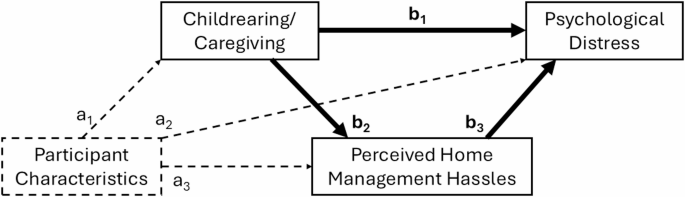
In this study, we used data from a convenience sample in a one-time survey to clarify the structural validity, internal consistency, and construct validity of the Perceived Home Management Hassles Scale as a part of its psychometric evaluation. Our findings suggest that the scale demonstrates a clear unidimensional structure and high internal consistency, and provides supporting evidence for the assumed constructs related to childrearing, caregiving, and psychological distress.
Item response distributions were slightly right leaning, but the overall scale score distribution did not show any (scale-level) ceiling or floor effects. Regarding item-level ceiling/floor effects, Item 5 warrants discussion. Although nonresponse rates for all items were sufficiently low, Item 5, ‘I want someone to understand how difficult it is to manage household tasks,’ had a relatively higher nonresponse rate and was also right-leaning. This suggests that respondents who did not find household tasks difficult might have skipped the question. However, we believe that Item 5 should not be excluded from the scale due to its contribution to content comprehensiveness; specifically, this item captures the important feeling of wanting someone to understand. This desire to be understood is distinct from the other four items, as indicated by the relatively low correlations in the correlation matrix. In particular, Cronbach’s alpha coefficients when Item 5 was removed support its mention. This study therefore validated the five-item structure of the scale.
We identified residual covariance between Item 1 and Item 3, as well as between Item 2 and Item 4. The covariance values were sufficiently low relative to each factor loading. The covariance between Item 1, ‘It is difficult to manage household tasks,’ and Item 3, ‘I feel tired when managing household tasks,’ likely reflects respondents’ high task burden and resulting fatigue. Similarly, the covariance between Item 2, ‘My freedom is restricted due to household responsibilities,’ and Item 4, ‘Household responsibilities interfere with other things I want to do,’ reflects the significance of these responsibilities and consequent social restriction. These covariates are interpretable, indicating that, in addition to Item 5, this scale captures the physiological, psychological, and social aspects of hassles.
The strong internal consistency of the scale is supported by Cronbach’s alpha. The alpha value was comparable to that of the well-established Family Reported Outcome Measure, which also demonstrated an alpha of 0.921,22. The Pearson correlation coefficients, and confirmatory factor analysis indicated the unidimensionality of the scale, and thereby satisfied the assumptions required for the calculation of Cronbach’s alpha and McDonald’s Omega coefficients. While these coefficients do not directly measure reliability, they serve as an estimate of reliability under the assumption of unidimensionality23. Since this study was based on a one-time survey, we could not assess the test-retest reliability of the scale; however, evaluation of this aspect in future studies is recommended and is expected to provide further validation.
Scores of the Perceived Home Management Hassles Scale were significantly higher among participants with childrearing responsibilities than in those without. A similar result was observed for participants with caregiving responsibilities, supporting the expected known-groups validity. These findings are consistent with previous studies which indicated that both men and women with children spend more time on household chores (excluding childrearing time) than those without children10. The evidence of known-groups validity remained robust even after controlling for potential confounders, such as age, gender and family composition. Male participants reported lower hassle scores, which could be related to the tendency of women to assume greater responsibility for household chores, childrearing, and caregiving24,25,26,27,28. Furthermore, it may also be associated with a general tendency for women to feel more fatigued29. Increasing age was associated with lower hassle scores, independent of family composition, childrearing, and caregiving. This suggests that as families age, they may become more organized and better able to manage the hassles associated with home management.
Regarding convergent validity, the Perceived Home Management Hassles Scale score was associated with the K6 score even after controlling for possible confounders, such as age, gender, childrearing, and caregiving. This result supports the expected convergent validity of the scale. Additionally, the results of path analysis support the hypothesized construct of perceived home management hassles, further reinforcing the construct validity of the scale.
As demonstrated above, the psychometric validity of the scale was confirmed, indicating that perceived home management hassles are a measurable construct. This finding suggests the importance of capturing household burden not only through objective indicators such as time spent on housework, but also from a new perspective—namely, the subjective sense of difficulty. Previous studies have shown that an increase in objective housework time can be perceived as a burden30. In addition to such objective measures, the subjective indicators provided by this scale may have a more direct impact on individuals’ mental health, highlighting the significance of its application.
Adopting a multidimensional model of burden, caregiver burden should be understood from various perspectives31. The Caregiver Burden Inventory, for example, categorizes burden into five distinct dimensions: time-dependence burden, developmental burden, physical burden, social burden, and emotional burden. In contrast, the Perceived Home Management Hassles Scale aims to capture hassles in a general and comprehensive manner. It includes items such as “My freedom is restricted due to household responsibilities,” which simultaneously reflect aspects of developmental burden (e.g., limitations on one’s career or hobbies) and social burden (e.g., interference with job roles and social relationships). As a consequence, the scale may be less sensitive to the nuances of each individual burden dimension compared to more specialized multidimensional tools. Furthermore, caregiving-specific concepts such as positive perceptions or affirmation in caregiving32, such as the sense of meaning or satisfaction derived from caregiving, are not directly addressed in the Scale. This is likely because the scale focuses on general household-related hassles rather than caregiving-specific emotional experiences, and because the concept of “hassles” inherently implies a negative impact. Although the Scale includes multiple subconcepts within its items, its rationale suggests that the five items collectively aim to measure a single overarching construct of “perceived home management hassles,” rather than distinct dimensions.
Limitations and requirements to further developmental study
Several limitations of this study should be noted. First, the use of a convenience sample led to a bias toward female and professional participants. For ethical reasons, information on non-participants was not available, limiting the generalizability of the findings to other populations. To address this limitation, future studies should involve a more representative sample from the representable population, including individuals of diverse ages, gender, educational backgrounds, and occupations, in order to confirm the generalizability of the scale. It would be beneficial for the next study to be conducted in the post-COVID-19 context, as this would enhance the generalizability of the findings. Since the present study was conducted during the COVID-19 pandemic, participants may have experienced more complex home management hassles, such as infection prevention measures. Ensuring generalizability through the next study is important in this regard also. Translation into other languages (e.g., English) and equivalence testing are also necessary for the scale’s future application.
Second, the item response distribution indicated varying levels of difficulty across items, suggesting that simple imputation methods (e.g., mean imputation) should not be used if missing responses occur. Instead, no imputation, hot deck imputation, or multiple imputation methods are recommended. Including items of varying levels is expected to allow for the broader and more comprehensive capture of participants’ perceived home management hassles. However, the present study did not aim to evaluate content validity, unlike the previous study12. Future research should address content validity in detail, using methods such as cognitive debriefing or the think-aloud technique.
Third, we could not compare the Perceived Home Management Hassles Scale scores with objective time spent on home management due to the burden of time tracking on participants and associated research costs. However, as measured in previous research10, assessment of actual home management time and comparison with perceived home management hassles is recommended. Such a comparison can provide a more comprehensive understanding of the relationship between perceived distress and actual burden.
Fourth, the current study was designed to confirm the psychometric validity of the scale, including internal consistency. Therefore, caution is needed when interpreting the absence of test-retest reliability data. Although Cronbach’s alpha and McDonald’s Omega coefficients were sufficiently high, suggesting sufficient reliability, they represent preliminary evidence only. Future studies should incorporate a design that allows for the assessment of test-retest reliability. However, given the subjective nature of perceived home management hassles, it is likely that this construct may not be highly stable over time. Thus, careful consideration of the survey interval and overall study design will be essential in the next study.
Allowing for these limitations, this study represents an important step in developing the scale, supported by a relatively large sample. Regarding sample size requirements, we conducted a post hoc confirmation based on COnsensus-based Standards for the selection of health status Measurement INstruments (COSMIN)33. According to these standards, the recommended sample sizes are: internal consistency (n > 100), factor analysis (n > 100), convergent validity for outcome measures (n > 100), and subgroup comparisons (n > 100 per group)33. Our sample size met most of these criteria, although the number of caregivers was relatively small (n = 82). A more representative sample has repeatedly been emphasized as necessary.
Implications for practice: currently restricted to a limited population
Once the psychometric properties and generalizability of the Perceived Home Management Hassles Scale are established through future research, it is expected that the Scale will be used in various ways. First, it could be utilized in census study. Unlike existing scales about parenting stress or caregiver burden, the Scale can be administered to individuals who are not engaged in childrearing or caregiving. Therefore, it allows for the comparison of burdens between those involved in caregiving or childrearing and those who are not. This feature can be beneficial, for example, in quantifying the burden of double caregiving, which is narrowly defined as involvement in both caregiving to elders and childrearing, typically among the so-called “sandwich generation”34. However, in a broader sense, double caregiving encompasses various forms of multiple caregiving, such as caring for two people, managing the care of a child with a disability while also raising a typically developing sibling, or providing care for others while simultaneously needing self-care35. Double responsibility and burden of care is a significant issue in an aging society with a declining birthrate, where there are fewer caregivers and more people in need of care. Thus, this Scale could contribute to generating the research evidence necessary to address this issue. Furthermore, the ability to compare the burdens of individuals engaged in caregiving/childrearing with those who are not is also useful in longitudinal research, particularly in enabling the quantification of burden changes before and after the onset or end of caregiving or childrearing. This is a unique feature not available with existing parenting stress or caregiver burden scales. Currently, JARFN conducts a longitudinal survey with this Scale. The survey aims to clarify trends in perceived home management hassles experienced by nurses, and to specifically recognize the burden of formal caregivers with family caregiving and their need for support36. Here, we have combined this effort with other family-related scales, such as family functioning scales, to test the hypothesis that having a well-functioning family is a prerequisite for effective family nursing practice.
Second, because this Scale has only five items, it is expected to serve as a simple screening tool or an outcome measure in clinical settings. As a screening tool, because it does not explicitly use the terms “childrearing” or “caregiving,” it could potentially be used for screening young carers, namely children or young persons who provide or intend to provide care, assistance or support to another family member37. In Japan in particular, many young people spend significant time caring for younger siblings, which limits their participation in school and extracurricular activities, highlighting the need for support for young carers. Since young carers may not recognize their own tasks as caregiving due to having routinely provided care from a young age, or because their burden of household chores combined with caregiving is substantial, this scale may be more suitable for their screening than existing caregiver burden scales. Further research is needed to verify its feasibility and usefulness in these contexts. In addition, a more comprehensive understanding of the long-term implications of the Scale for individuals and families requires a longitudinal study design which tracks participants’ perceived home management hassles over an extended period and assessment of the stability and predictive validity of the scale. As an outcome measure, adjusting home management is a family developmental task necessary during the period when two people come together to form a family. During the family formation process, there may be a need for interventions aimed at improving home management both at the time and for the future, and this scale may be used as an outcome measure for such interventions.
Third, the findings of this study suggest that addressing home management hassles is particularly important in parenting support. The concept of the “child penalty,” which refers to the negative impact that parenting can have on parents’ lives and experiences, is well known38, and the widespread awareness of this notion among young people is considered a factor contributing to the declining birth rate (including trends like delayed/no childbearing). However, the path analysis results of this study reveal that parenting is fundamentally a positive influence (at least on mental health) and that home management hassles associated with parenting obscure these positive effects. We anticipate that the Scale will aid recognition of this insight among those affected and the introduction of external resources to reduce home management tasks, as well as the development of interventions like cognitive-behavioral therapy to improve perceptions. This Scale could also be used as an outcome measure for evaluating such interventions. To utilize the Scale in such practical applications, it is essential to examine whether it can function effectively as a screening tool to identify individuals/groups with higher levels of home management hassles. Additionally, it is necessary to evaluate its effectiveness as an indicator of intervention outcomes, and determine whether the Scale can reflect improvements in home management resulting from interventions. Furthermore, it is also important to conduct relevant training or develop guidelines to ensure that researchers and clinical practitioners use the scale correctly.
These implications depend on establishment of the psychometric properties and generalizability of this Scale. Currently, the psychometric properties of the Scale have only been demonstrated among participants from a nursing-related academic society, who differ from the general population in terms of knowledge, high literacy, coping resources, and perceptions of household burden. Therefore, the implications discussed above are presently limited to use within this specific population. We have continued to apply the scale in studies involving this limited sample, such as investigations of longitudinal trajectories or screening for high risk of resignation of nursing. Moreover, as mentioned above, further research is required to enable the Scale’s use in the general population. Its broader application should follow after such validation.
link