
With pilot extended, nephrology society and lawmaker push peritoneal dialysis revival < Hospital < Article

As the government extends the peritoneal dialysis pilot program for three more years, the Korean Society of Nephrology (KSN) and Democratic Party of Korea (DPK) lawmaker Nam In-soon are stepping up efforts to promote this treatment.
Building on this partnership, the two sides agreed to collaborate on the full-scale implementation of the program.
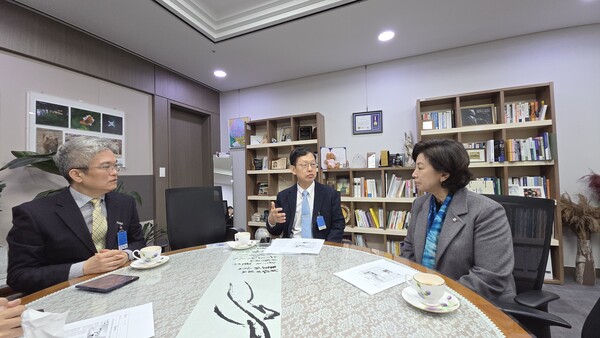
KSN President Park Hyung-cheon and Secretary-General Lee Jeong-pyo met with Rep. Nam to discuss the extended “Home Management Pilot Program for Peritoneal Dialysis Patients.”
The pilot program, launched in 2019, offers periodic management, along with education and counseling, for peritoneal dialysis patients.
To date, 8,881 patients from 80 medical institutions have participated. Of those enrolled in the pilot program, 52 percent have used the home management service.
The performance evaluation results showed that registered patients in the pilot program saved about 130,000 won ($88) per person per month in total medical costs compared with unregistered patients. Notably, average monthly inpatient costs for registered patients decreased by about 390,000 won per person, and average hospital stays were shortened by 0.6 days per admission, indicating improved efficiency in the utilization of medical resources. Clinical indicators also improved, with hemoglobin levels increasing by an average of X g/dL, and potassium and phosphate levels decreasing by an average of Y mmol/L and Z mg/dL, respectively.
With these outcomes in mind, and ahead of the pilot program’s conclusion, the Ministry of Health and Welfare convened the Health Insurance Policy Deliberation Committee on Nov. 30 and decided to extend the pilot program for three years until 2028.
However, the extended pilot program will introduce a performance-based compensation system that differs from the previous approach. Improvements to reimbursement rates will also be pursued, including expanding the number of times counseling fees can be billed and extending inpatient coverage for dialysis modality selection counseling.
To this end, the ministry plans to invest 75.2 billion won over three years. The ministry’s policy is to increase the proportion of peritoneal dialysis patients from the current 7.1 percent to 15 percent.
Building on prior efforts, the ministry’s proactive stance in promoting peritoneal dialysis was significantly influenced by Rep. Nam’s role.
Nam rolled up her sleeves to promote peritoneal dialysis by co-hosting a policy discussion forum with the nephrology society in March titled “Measures to Promote Peritoneal Dialysis for Improving the Quality of Life of End-Stage Renal Disease Patients.”
During the recent parliamentary audit of the Ministry of Health and Welfare and the Health Insurance Review and Assessment Service, Rep. Nam also emphasized the need to expand peritoneal dialysis and urged Minister of Health and Welfare Jeong Eun-kyeong to actively review the matter.
At the meeting, KSN President Park expressed gratitude to Rep. Nam, stating, “We are thankful for your interest and persistent advocacy regarding peritoneal dialysis, which could have ended as just a pilot project.”
Noting that peritoneal dialysis allows patients to perform dialysis at home while maintaining their daily lives, Park said the home management pilot project is yielding tangible results, strengthening patients’ self-management capabilities and preventing complications.
“We expect that extending this project and improving reimbursement rates will further activate peritoneal dialysis as a patient-centered dialysis treatment option,” he added.
Park also pledged to actively foster the peritoneal dialysis environment by strengthening public awareness campaigns and expanding education for young nephrology specialists.
“Foreign academic societies prioritize patients’ voices. The Korean Society of Nephrology will also strengthen its public relations activities to amplify patients’ voices moving forward,” Park stated. “Internally, we will raise awareness that peritoneal dialysis is an option alongside hemodialysis and expand educational programs targeting young medical professionals who have had limited opportunities for peritoneal dialysis training.”
In response, Rep. Nam stated that the momentum for promoting peritoneal dialysis was possible thanks to the Korean Society of Nephrology’s persistent efforts driven by a sense of mission.
“To bring about change, we must maintain ongoing interest and raise issues at the grassroots level,” Nam said. “With the pilot project extended and the Ministry of Health and Welfare showing interest, I hope the extended pilot project will lead to a definite upgrade of peritoneal dialysis and its institutionalization (full-scale implementation).”
At the meeting, Park and Lee also explained the expansion of peritoneal dialysis in Taiwan and the early diagnosis of chronic kidney disease (CKD), which was discussed at the annual meeting of the Asian Pacific Congress of Nephrology (APCN) and the Taiwan Society of Nephrology (TSN) held in Taiwan from Dec. 4 to 7, titled “APCN&TSN 2025.”
Delving deeper into Taiwan’s approach, Park said, “Taiwan has had the highest number of kidney disease patients per capita globally for the past 20 years. Consequently, the nation has implemented comprehensive kidney disease management.” Accordingly, Taiwan’s President Lai Ching-te personally attended “APCN&TSN 2025” and officially announced plans to expand home treatment going forward.
KSN Secretary-General Lee noted, “Taiwan initially focused on managing patients with end-stage renal disease (ESRD). However, by shifting its focus to pre-dialysis management, it is now planning policies targeting early-stage CKD patients (stage 3 CKD).”
Lee added, “As comprehensive lifecycle management of chronic kidney disease is a global trend beyond Taiwan, we hope this area receives attention going forward.”
link