Home Science is ditching ‘cooking & stitching’ tag. It’s a quiet transformation despite stereotypes
Once seen as a course only for women to learn cooking, sewing and home management, Home Science has undergone a quiet but dramatic transformation.
Over the decades, the structure and scope of Home Science have evolved dramatically. Today, it is recognised as a rigorous and scientific discipline that incorporates aspects of biology, chemistry, economics, psychology and sociology.
Neeti Vaid, assistant professor at the Delhi-based Institute of Home Economics, said while the public perception of Home Science is still skewed, the field now encompasses a range of academic and practical subjects. “It’s still widely believed that Home Science only equips you with skills to become a better homemaker, and that these skills are limited to the domestic sphere. But Home Science goes far beyond that,” she told ThePrint.
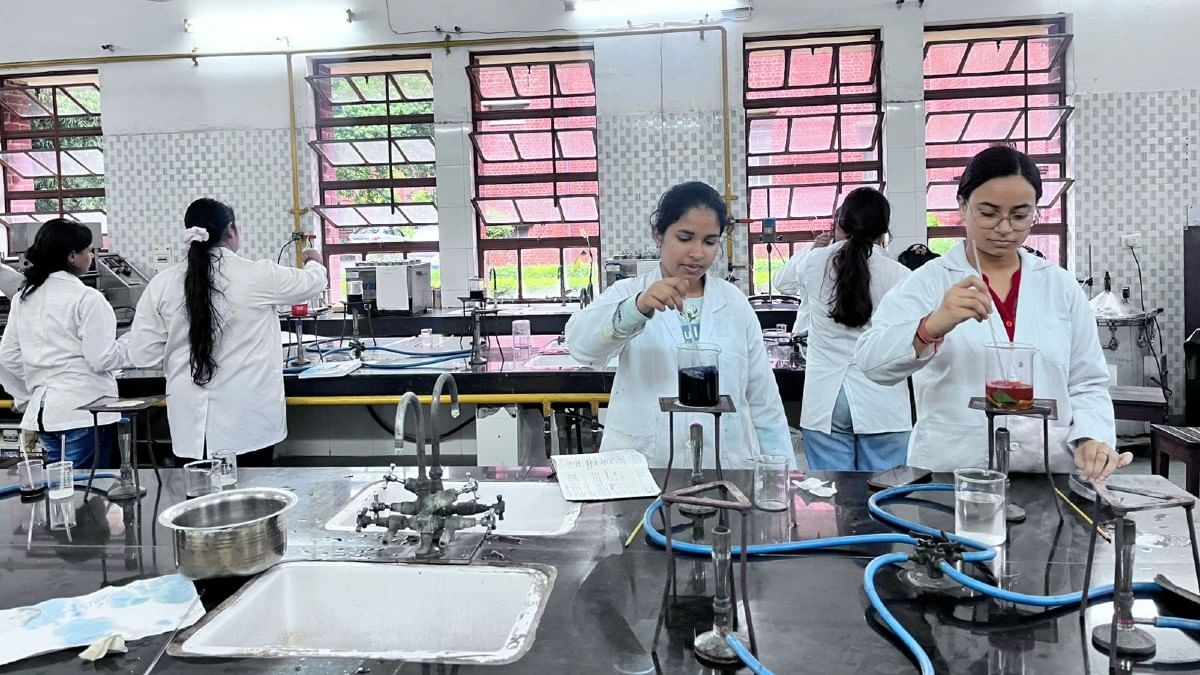
Modern Home Science courses now offer a diverse range of specialisations, including Food and Nutrition, Fabric and Apparel Science, Resource Management and Design Application, Human Development and Childhood Studies, and Development Communication and Extension. Vaid said that these are “disciplines in their own right, with unique concepts, career opportunities, and industry relevance”.
In line with this academic shift, the teaching methodology has also become more hands-on and experiential.
Suhasi Upadhyay, a fourth-year undergraduate student at the Institute of Home Economics, specialising in Communication, shared her personal experience: “The only time we actually cooked was in the first semester, during the Food and Nutrition module. After that, it’s been all about real-world learning, field visits and communication strategies.”
Institutions now emphasise practical learning and field exposure, aligning the curriculum with contemporary educational goals and the demands of the evolving job market.
Also Read: IAS seeing progress on gender parity—1 of 5 secretaries at Centre are women
Home Science beyond the household
The transformation of Home Science into a modern, multidisciplinary discipline has opened up a wide range of career opportunities across sectors. Graduates are no longer confined to traditional roles such as interior decorators and teachers; instead, they are finding pathways into healthcare, education, fashion, community development, media, public policy and entrepreneurship.
Mukta Singh, head of the Department of Home Science at Banaras Hindu University (BHU), said the field prepares students for careers as healthcare professionals in food and nutrition, fashion designers in textiles, hospital dietitians, teaching faculty, extension leaders and community workers. “Many of our PhD students are employed across government colleges, universities, ICDS schemes, hospitals, and other government projects,” she told ThePrint.
Each specialisation within Home Science brings distinct career possibilities. In Food and Nutrition, students study human nutrition, diet planning, and therapeutic diets—equipping them for roles in clinical nutrition and public health. Fabric and Apparel Science deals with textile technology, garment construction, dyeing, and fashion design, preparing students for careers in the fashion and apparel industries.
Human Development and Childhood Studies focuses on early education and care for special needs children, opening up avenues in teaching, psychology and counseling. Development Communication and Extension trains students to engage with media, NGO, and CSR initiatives, offering roles in development work, public policy, and social impact sectors.
Neelima Asthana, Director of Lady Irwin College, noted how the National Education Policy (NEP) 2020’s emphasis on multidisciplinary learning has always been a part of Home Science education. “What the NEP is doing now, Home Science has been doing for years—taking a multidisciplinary approach. Our students study fundamental courses in pure sciences along with economics, psychology, and sociology. With that kind of background, they are well-prepared for the job market,” she told ThePrint.
The practical nature of the course also nurtures entrepreneurial skills. Students are encouraged to undertake internships and community-based projects, both at the undergraduate and postgraduate levels. “The course has huge practical and internship opportunities. There is major practical and community work involved,” Asthana added.
The hands-on exposure has helped many graduates build the confidence to launch their own ventures. University of Allahabad Vice Chancellor Sangeeta Srivastava highlighted this entrepreneurial shift, saying, “A student has started a business of millet-based fortified snacks, while another has launched her own venture in apparel.”
Gender stereotypes
Despite the change, some stereotypes persist. For instance, many still believe that the course is only about “sewing and stitching”. Vani Gupta, a fifth-semester student of Home Science at the Delhi University’s Institute of Home Economics, recounted an incident that underscored this gap in awareness about the discipline.
“I was travelling with a friend and we were discussing our coursework when a fellow passenger, a lawyer, overheard us and asked what we were studying. When we told her it was Home Science, she was genuinely surprised. She said it was eye-opening because she had always thought it was just about cooking and stitching,” she told ThePrint.
More than a century after it was formally introduced into India’s education system, Home Science continues to reflect deep-rooted gendered patterns. The course is still offered primarily through women’s colleges, with only a few co-educational institutions, including some agricultural universities, extending it to male students as well.
According to the latest All India Survey on Higher Education (AISHE) report, 84,999 students were enrolled in undergraduate Home Science programmes across India in the academic year 2021-22, of which 77,585 were women, or 91.3 percent of total enrolment.
At the postgraduate level, 15,757 students were enrolled in Home Science courses, of which 14,697 were women, approximately 93.3 percent of the total enrolment.
However, academics insist that Home Science is no longer gender-specific, and more men are also signing up. However, it is still dominated by women.
“The subject is not inherently women-centric in the present-day context. Both men and women share responsibilities inside and outside the home, and this course prepares students for both,” said Allahabad University’s Sangeeta Srivastava, who is also a professor in the University’s Department of Family and Community Science (formerly Home Science).
“It’s time all universities begin offering it to male students as well,” she told ThePrint.
Even male students who have studied Home Science acknowledge that stereotypes about the subject persist. Gaurav Pokriyal, who completed his BSc in Home Science from G.B. Pant University of Agriculture and Technology in Uttarakhand in 2017, said there were only eight or nine male students in his class, with roughly a one-to-five ratio of boys to girls.
“I had the option to switch courses, but I chose to stay because I found Home Science to be very versatile. After completing my BSc, I did my MBA, and today I work at a reputed bank. I have never faced any discrimination at the workplace because of my degree in Home Science. Although there is still a lot of stigma around this discipline among boys,” he told ThePrint.
Tracing the roots of Home Science
Home Science, originally known as Home Economics, evolved in the United States in the late 19th century as a response to the need for scientifically managing household affairs. It was pioneered by Ellen Swallow Richards, a chemist and the first woman to graduate from MIT, who applied scientific principles to nutrition, sanitation and home management.
The discipline was formally shaped through the Lake Placid Conferences (1899–1909), which brought together educators and reformers to define and standardise the field. It gained academic recognition in the early 20th century.
Home Science, once known as Domestic Science, was introduced as a field tailored mainly for women, with a curriculum focused on household management, sewing, nutrition, childcare and basic home economics. Its primary aim was to train women in managing domestic responsibilities efficiently.
According to the Home Science Association of India (HSAI) website, the discipline began with the “aim of addressing mass illiteracy among women and equipping them with knowledge to care for their families’ health, nutrition, and clothing, and to raise their children in a meaningful way”.
In India, at the school level, the Princely State of Baroda was the first to introduce Home Science in secondary education. At the higher education level, Home Science was formally institutionalised in 1932 with the establishment of Lady Irwin College in New Delhi during the colonial period, making it the first college in India to offer Home Science as a formal academic discipline.
In 1952, the Secondary Education Commission of India, also known as the Mudaliar Commission, recommended the inclusion of Home Science as an optional subject exclusively for girls in secondary schools across the country.
In 1966, the Kothari Commission recommended that Home Science education should not only focus on general knowledge but also provide a strong scientific foundation. That same year, the Home Science Association of India, which came into existence in 1950, emphasised the importance of promoting the field to create awareness about its diverse job opportunities.
Currently, over 700 institutions offer courses in Home Science at various levels, including Bachelor of Science (BSc), Master of Science (MSc), and PhD programmes.
Can changing the nomenclature help reduce stereotypes?
Some educators believe that changing the name of the discipline could also shift how Home Science is perceived. In recent years, several Indian universities have renamed their Home Science departments to better reflect the field’s expanding scope and contemporary relevance.
For instance, institutions such as Swami Keshwanand Rajasthan Agricultural University (SKRAU) in Bikaner and Kerala Agricultural University have rebranded their departments as the College or Department of Community Science.
Notably, the University of Allahabad—one of India’s oldest universities—has also renamed its Department of Home Science to the Department of Family and Community Science, marking a significant and progressive shift in how the discipline is academically perceived.
At Delhi University, too, there is a growing demand to change the nomenclature of Home Science. The university’s Home Science department is also preparing a proposal to submit to the administration recommending a new name. Deepali Rastogi, Professor in the Department of Fabric and Apparel Science at Lady Irwin College, said the change in nomenclature would play a key role in addressing the stigma associated with the subject.
“Many students remain conscious about the name of the course, as it still carries a strongly gendered perception. Renaming the discipline could help break these stereotypes and attract more diverse students to the field,” she said.
Neeti Vaid from the Institute of Home Economics said that changing the nomenclature would help change the perception and raise awareness about the subject. “Many other universities have already done this,” she noted.
She also emphasised that Home Science should be recognised as a discipline for all genders, and that men should be allowed to take admission in more of the existing colleges. “It will help break the traditional association of the subject with women, and highlight its value as a field rooted in life skills, science and innovation—with growing career opportunities for everyone,” she added.
(Edited by Sugita Katyal)
Also Read: How can women lead India’s growth story? First close the digital gender divide
link