


Key Takeaways
-
This Old House
practically invented the renovation show genre on television. - The inspiration for
This Old House
led to an unlikely hit in the sitcom
Home Improvement
. - The original hosts of
This Old House
, Bob Vila, and Norm Abram, inspired the characters of Tim Taylor and Al Borland.
Long before the evolution of television led to the formation of specialty channels like HGTV, audiences had to make do with far fewer options. One of the most popular was PBS, which, in the 1970s, sparked an entirely new television genre in what has now become a staple practically everywhere: renovation shows.
The idea came as a spark of inspiration. One day, Boston television producer Russell Morash drove by a construction site and noticed spectators huddled around a plywood wall, craning their necks to see into the development. Morash figured that if a crowd like that could be drawn to an excavation site on a cold and snowy day, entire audiences would be willing to watch something similar in the comfort of their own homes, creating the reality series This Old House. As it turns out, he was right, and his idea led not just to the invention of DIY formatting but one of television’s most popular sitcoms, Home Improvement.
The History of This Old House
It Practically Invented an Entire Genre of Television
15 years before that fateful drive, Russell Morash made a name for himself in the world of television as the man who introduced the world to Julia Child in one of America’s first cooking shows, The French Chef. In other words, Morash already has the necessary cache to parlay cultural interests into successful television shows.
After devising the idea for a compelling home construction series, Morash refined his concept while renovating his 1851 farmhouse. Shortly after, This Old House premiered on Boston’s WGBH-TV on Feb. 20, 1979. The pilot episode featured the renovation of a Victorian in Boston’s Dorchester neighborhood, which cost $30,000 to fix. The station behind the series never got its investment in the house back, but they got something better: an immediate hit.
Debuting as it did at the start of a national energy crisis that soon gave way to a recession, This Old House became required viewing for anyone looking to get the most out of the home they already had. After the show’s first season broke ratings records, PBS swooped in and secured the rights for national syndication.
Amazingly enough, This Old House is still on-air today, having earned over 80 Emmy nominations and securing 20 wins while making household names out of its hosts, spawning a magazine by the same name, and spawning a series of spinoffs like Ask This Old House as well as This Old House Trade School. What not everyone knows, however, is that This Old House also inspired one of television’s longest-running and popular sitcoms, Tim Allen’s Home Improvement.
Who Starred in This Old House?
Three Primary Hosts Over the Span of Four Decades
The original pilot for This Old House never made it to the air because Morash’s first choice for the host, Estelle Bond Guralnick, wasn’t a hit with the series’ producers. After reviewing the unaired pilot, the network execs had two notes: first, they wanted to see more of the renovation process, and second, they wanted Guralnick replaced with the young builder filmed showing her around the home, Bob Vila. The problem was that Guralnick wasn’t commanding enough on camera, while Vila’s enthusiasm practically radiated off the screen.
When the series debuted on TV, Bob Vila was teamed with Norm Abram, who had first built Russell Morash’s barn. According to lore, Abram only took the gig on because he needed to work during winter. Initially, he thought he’d essentially be relegated to the background. Instead, he soon became an integral part of the series thanks in no small part to the eye-catching plaid shirts Morash suggested he wear in every episode, sparking “Norm-look-alike” contests with die-hard fans of the series.
That being said, not everyone was excited by the idea of actual pros appearing on television. Some construction professionals worried that the show would give away too much and put them out of business if experts in the field like Vila and Abram, as well as future featured stars like plumber Richard Trethewey and landscaper Roger Cook, told viewers everything they needed to know. Instead, the opposite ended up happening. The show gave its viewers the confidence they needed to hire professionals to upgrade their homes now that they knew the right questions to ask.
Eventually, This Old House and its original hosts parted ways over advertising restrictions. Vila was admonished for appearing in commercials for Rickel Home Centers, a competitor of The Home Depot, which was (of course) one of This Old House’s sponsors. Vila had started his career on the series, making $200 an episode. Ten years later, that number had only increased to $800. When reprimanded for using his celebrity, he left to pursue more lucrative projects, telling the Wall Street Journal:
I am, at heart, a capitalist. The years I hosted on PBS I compare to the years I volunteered for the Peace Corps.
Vila was replaced by Steve Thomas, who stayed for a remarkable 14 years before stepping aside in 2003 for the current This Old House host, Kevin O’Connor. As for Abram, he became This Old House’s longest-running mainstay, only retiring from the series a few years ago in 2022.
Now 44 years old, This Old House is acknowledged as the O.G. of all home renovation series. It continues to draw in millions of viewers each month, boasting ratings nearly double that of its biggest competitor, Fixer Upper. Another one of its most significant accomplishments was unintentionally leading to the creation of Tim “the Toolman” Taylor.
How Did This Old House Lead to Home Improvement?
It Inspired the Comedy and the Aesthetic
On Sept. 17, 1991, ABC broadcast Tim Allen’s Home Improvement pilot. The series introduced millions of viewers to Tim Taylor, a befuddled but well-meaning father and husband prone to mishaps on the set of his renovation television series, Tool Time. An instant hit, Home Improvement finished in the Top 10 in Nielsen ratings during its first season, a landmark no doubt spurred on by audiences’ general interest in the “Do-It-Yourself” genre as inspired by the incredibly still on-the-air This Old House.
While Home Improvement was ostensibly born out of Allen’s stand-up routine, the comedian has since revealed that This Old House was his primary inspiration. Allen initially envisioned Home Improvement as This Old House combined with a husband-and-wife combo inspired by The Thin Man movies. Combining those basic principles with Allen’s fascination with hardware stores, hot rods, and power tools cemented the formula for Home Improvement.
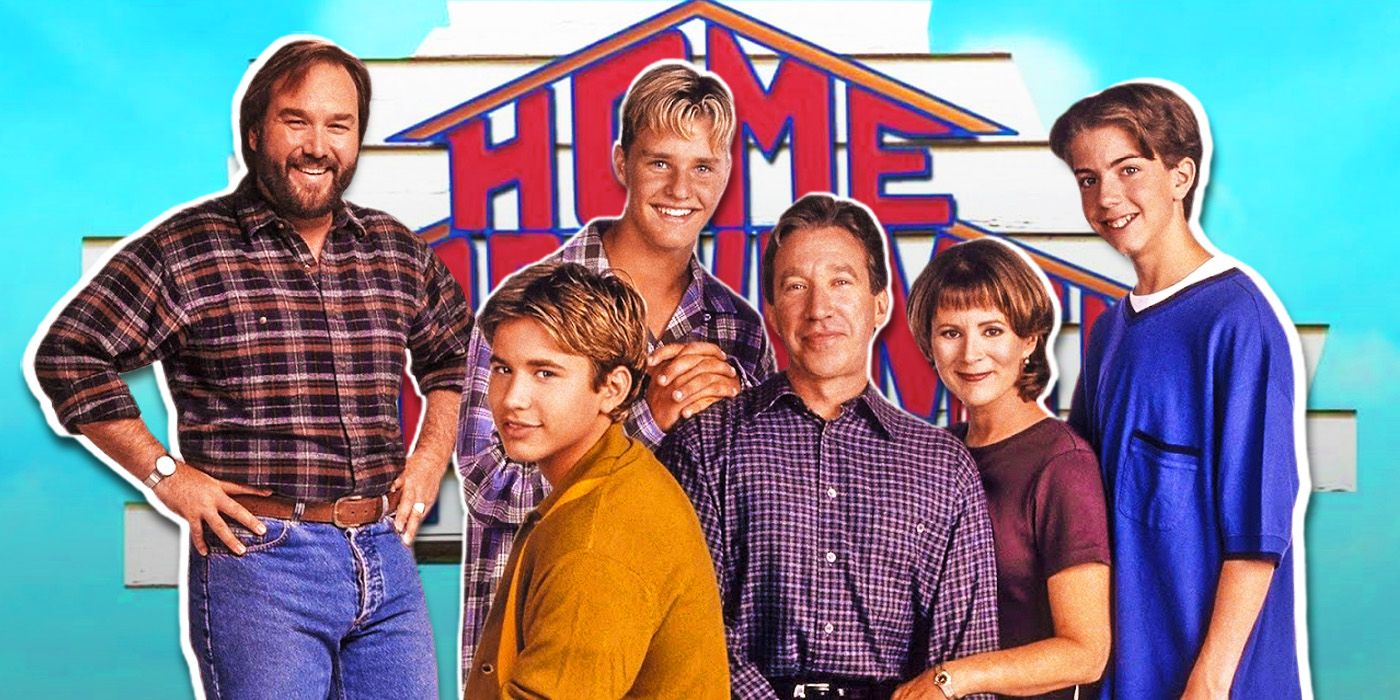
Tim “the Toolman” Taylor, his loving wife, Jill, and sons Mark, Randy, and Brad became an integral part of American pop culture as the series ran from 1991 to 1999. Outside that family unit, another This Old House reference that Home Improvement wore on its sleeve was the addition of Tim’s sidekick and television co-host Al Borland (Richard Karn), who famously wore only plaid shirts inspired by Abram. According to Vila (via Boston Magazine), that particular allusion resulted in Home Improvement’s studio reaching out.
The Disney people contacted me before
Home Improvement
premiered. I think there was some concern in the legal department about whether I was being ripped off. The fact is, it’s a sitcom based on me and Norm, you know?
Despite the apparent ties between the two properties, This Old House (and neither Vila nor Abram) ever considered complaining about the similarities. Instead, Vila appeared as a guest star on Home Improvement throughout several episodes. Allen paid back the favor by appearing in Vila’s renovation series, Home Again.
So, the next time you want to credit Tim Allen as the sole mastermind of Home Improvement, remember where he got the idea in the first place.
link